Sounds of Comfort and Care

On a chilly morning, I find the rhythmic sound of the dryers at Manna House tumbling clothes cozy and comforting. I feel coziness from the dryer’s warmth being shared with the clothes. And I feel comfort from old memories of hearing the dryer at home where my basement bedroom was located just off the laundry room. In this coziness and comfort, I experience a sense of peace, a sense of being at home. Home is not only where the heart is; home is also where the laundry is done.

Like home, doing laundry is a constant at Manna House. Unlike home, with twenty guests showering each morning, our laundry is heavy on towels and washcloths. And there is also a larger than normal number of other items to be laundered. Guests who shower get a complete set of fresh clothing, and they turn in their socks, underwear, jeans, t-shirts, long-sleeve shirts, and sweatshirts. We launder all the clothes that are salvageable.

The large loads of laundry remind me that doing laundry is not only a part homemaking, it is also a sacred practice within hospitality. We have this laundry to do because we welcome Christ in the guests and Christ comes wearing dirty clothes and needing a shower. So, doing the laundry at Manna House is doing Christ’s laundry. And Christ’s dirty clothes smell, but not like incense.

As I listened this morning to the dryers, I knew Christ’s laundry had been washed and was clean, with laundry sheets providing an additional fresh smell. With this in mind, the rhythm of the dryers, also felt like the comfort of a familiar hymn, singing of God’s presence when hospitality is offered. 

Warmth. Memories. Home. Hospitality. Divine Presence. I guess they were all tumbling around in the dryers. I was reassured by the sound of care, of being nurtured and loved. And in these days when people without homes are offered punitive policing, when homes are destroyed by immigration officers, cities are occupied by military forces, food is denied to the hungry, when the nation’s constitutional household is under attack, and the specter of resuming nuclear weapons testing threatens our home planet, I need these sacred reminders of God’s comfort and care, of God’s call to home. 

All around there is deep injustice, corruption, venality, meanness. Here in the laundry room at Manna House, I hear a counter-sound in the dryers, a revolutionary resistance to these times. God speaking as the clothes turn, “Comfort, comfort my people…with gentle words, tender and kind” (Isaiah 40:1-2).
I Thirst

As I arrived at Manna House a guest said, “Could you get me some water? I’m really thirsty.” He along with a few others were waiting for me to open the gate to the front yard. They are the early arrivers, hoping to get on the shower list.  

The heat and humidity have been unrelenting the past few weeks. Guests arrive exhausted, drenched in sweat, thirsty. The numbers of guests who come early is increasing.

Though it’s well over an hour before the morning hospitality will begin, I go into the house and get a pitcher of cold water and some cups. When I return to the porch everyone is delighted to get a drink. Several ask for and receive refills. It only takes a few minutes, but the relief on the faces of the guests is obvious. A drink of cold water will make their wait a bit more tolerable.

Once Manna House is open, we have a water cooler in the backyard. It empties quickly as thirsty guests drink cup after cup of water. We will refill this five-gallon cooler three or four times before the morning is over. 

Water. The Bible is filled with references to water. For the biblical writers living in semi-arid lands, water is precious. Water for them, as for us, is life. 

In Psalm 23, the Bible speaks of water as signifying God’s presence. 

The Lord is my shepherd, I lack nothing.

    He makes me lie down in green pastures,

he leads me beside quiet waters,

    he refreshes my soul.

The Bible sees the provision of water as a provision made by God. When Hagar and Ishmael are near death in the desert, God provides water (Genesis 21:8-21). In the Exodus story as the people of Israel move through the desert, they thirst, and God provides water (Exodus 17). Isaiah the prophet often uses water to symbolize the care God has for God’s people, “For I will pour water on the thirsty land, and streams on the dry ground; I will pour out my Spirit on your offspring, and my blessing on your descendants” (Isaiah 44:3, see also 49:10, 58:11). In the prophet Amos, water symbolizes the full coming of God’s justice, “Instead, let justice flow like a stream, and righteousness like a river that never goes dry” (Amos 5:4).

When Jesus on the cross says, “I thirst,” the violence of his execution is intensified by his need for life giving water (John 19:28). Those who stood by and mocked him did not bring him water to drink. They give him vinegar. Earlier in his life Jesus taught, “Whatever you do unto the least of these you do unto me,” and he identified with those who need water, “I was thirsty, and you gave me something to drink” (Matthew 25:31-46). 

Our guests thirst because water is hard to come by on the streets. Like Jesus’ executioners mocking him as he thirsts, businesses respond to those crucified on the streets by posting, “Restrooms for customers only.” Water in our society is a commodity reserved for those who can pay. As a city we have very few public water fountains, and they typically do not work. Memphis, like most major cities, is not hospitable to people on the streets. 

In the Book of Revelation, a vision is shared in which water fulfills God’s healing of the whole creation. Water is redemptive. 

Then the angel showed me the river of the water of life, bright as crystal, flowing from the throne of God and of the Lamb through the middle of the street of the city; also, on either side of the river, the tree of life with its twelve kinds of fruit, yielding its fruit each month. The leaves of the tree were for the healing of the nations (Revelation 22:1-2).

In contrast to this joyous vision of life-giving water, there is the angry and hateful rhetoric of today’s rulers who reject the joy of God’s reign. Their politics of scarcity and fear cannot imagine a world in which we share basic goods like water. Instead, for them everything has a price. The cash nexus determines all human relationships. 

After I had served water to the guests on the front porch, I went back into the house to set up for the morning’s hospitality. I was thankful. The thirsty guests had invited me into the joy of God’s reign. As I shared cold water with them on a hot morning, I sensed the loving, liberating, and life-giving presence of God. God had brought me to the water.

Start Small, Stay Small

Therese of Lisieux and Dorothy Day emphasized “the little way” or what Shannon K. Evans terms “the worthiness of the small.” The little way endorses being modest and not running after grandeur and the grandiose. About twenty years ago, those of us gathering to discuss a vision for hospitality for Manna House sought to be faithful to the little way. We committed to starting small and staying small. Hospitality, we believed, required welcoming our guests as individual persons with names, stories, dignity. We did not set as goals “ending homelessness”, or “saving” people.” Rather, we sought to offer hospitality, to meet a few modest needs in a little way that would respect our guests as human beings made in the image of God.

            I have found over the years that I sometimes fall into three temptations to abandon hospitality animated by this little way. 

In the first temptation, I seek control over those we welcome. This is evident whenever I focus on being more efficient. In offering showers, I try to do more and more showers in less and less time. In offering “socks and hygiene” I just hand over what we have instead of taking the time have each guest say what they want. When I seek control, I forget that “efficiency is the work of the devil.” Instead, I fall into the oxymoron of “efficient hospitality.” When I seek to be in control, I offer hospitality according to my convenience and desires. I rush guests rather than respect them as persons.

            In the second temptation I engage in the opposite of control. I practice a grandiose generosity in which “anything goes.” I violate boundaries. I give without concern for consistency. If a guest asks for it, I give it. Like control, anything goes is more about my desires than hospitality. I desire to be lauded as generous, as kind-hearted. Anything goes feeds my desire to be a savior who can do everything for everyone.

            The third temptation is also grounded in my expansive ego and reflects the oxymoron of “successful hospitality.” In this temptation, the hope I have for every guest, that they will have good lives, gets distorted into my desire to remake guests in my image. In this temptation, I measure my “success” in hospitality by how many people I get off the streets. I use my white middle class standards to define what our guests should aspire to. I want them to conform to my social standards of respectability. I deny their agency, their hopes, dreams, desires, and woundedness—their personhood. They become means to my ends. 

            In contrast, hospitality offered in the “little way” asks me to simply welcome people as they are. As Michael Sean Winters writes, “Success is not a Gospel category.” Rather than pushing others to conform to my expectations, I must drop my ego, and allow the guests to change me. In hospitality it is much more likely that the guests save me rather than the other way around. This was Jesus’ point when he said, “Whatever you do unto the least of these you do unto me” (Matthew 25:31-46), and when Paul said, “Welcome one another as Christ has welcomed you” (Romans 15:7).

            So, the hospitality offered at Manna House in the little way is not much. Two mornings each week for showers, socks and hygiene, coffee, sanctuary. One Monday meal each week. Each morning, six to eight volunteers, 100 or so guests. We do not pretend to be efficient, to provide a “solution” to homelessness, or to meet every need or to successfully remake people on the streets into productive citizens. 

Our purpose is hospitality, not charity doled out from above nor social services to get people back into the system. We do not get people off the streets or out of poverty. We provide a place for people to be welcomed as people. It is a small thing. It doesn’t amount to much. Like a mustard seed. And we hope, in the words of the prophet Zechariah, we will “not despise these small beginnings, for the Lord rejoices to see the work begin” (Zechariah 4:10).

“Have You Ever Lost Hope?” Easter Arrives at Manna House

“Have you ever lost hope and tried to commit suicide or homicide?” The question startled me.

At the end of the morning’s hospitality at Manna House, I had sat down on a couch in the living room. A few photocopied leaflets had been left on the couch, apparently to be shared with our guests. The leaflets were handwritten. At the top were the words, “Homelessness Incorporated” with the question just below. “Have you ever lost hope and tried to commit suicide or homicide?” 

Sometimes I forget the amount of despair our guests carry. As Kathleen says, “They bring us their best.” And for most of our guests, most of the time, that is true. Despite being on the streets, our guests are typically kind, gentle, courteous. The ones who come with an edge, sullenness, or a sour disposition are so few that they are memorable.

Yet, the question surfaced the reality below the manners and sociability. Life on the streets is hard, deadly hard. 

Even though we try to offer hospitality with respect and graciousness, it is inherently humiliating to ask for a shower or clothing, or some other need to be met. St. Vincent de Paul got this when he wrote many years ago, “It is only for your love alone that the poor will forgive you the bread you give to them.” What we offer can so easily denigrate and dehumanize those we seek to serve. We can be agents of despair. We offer goods everyone ought to have; goods that are basic to human dignity. Yet those goods are shared by getting on a list and then waiting for one’s name to be called.

“Have you ever lost hope?” How hopeful can one be when the next meal, the next shower, the place to safely sleep, the security of a home—are all in question?

Finding this note on the Monday after Easter, I had to wonder about hope in the midst of suffering, humiliation, and injustice, and the way hospitality both resists and is implicated in those. 

Resurrection hope is not an easy hope. Such hope only comes through the cross, as Jesus said, “My God, my God, why have you forsaken me?” He took those words from Psalm 22:1, which carries both despair and hope, together. Immediately following forsakenness come words of hope, “Yet you are enthroned as the Holy One; you are the one Israel praises. In you our ancestors put their trust; they trusted, and you delivered them. To you they cried and were saved; in you they trusted and were not put to shame” (Psalm 22:3-5).

“Have you ever lost hope?” Acknowledging the loss of hope means I once had hope. I know what hope is, a trust in the goodness of life, that there is meaning to my life and the lives of others. Resurrection affirms loss is real, death is powerful, and so are those who impose death. But resurrection also affirms something more real and more powerful, life, love, and liberation. Those keep blossoming up despite all odds, like the dandelions emerging from the cracks of cement each spring, or hospitality offered with love. 

“Practicing resurrection,” Tex Sample writes, “involves a radical reorientation that places us in proximity with people who are poor, oppressed, marginalized, excluded, and silenced.” Why? Because if I believe in resurrection, in the power of hope and love, I have to practice resurrection with people being crucified, who wonder if God is forsaking them. I have to love, to offer hospitality and seek justice, in the face of the question, “Have you ever lost hope?”

Fear Not!

The angel of the Lord is encamped around those who revere God to rescue them. Psalm 34:7

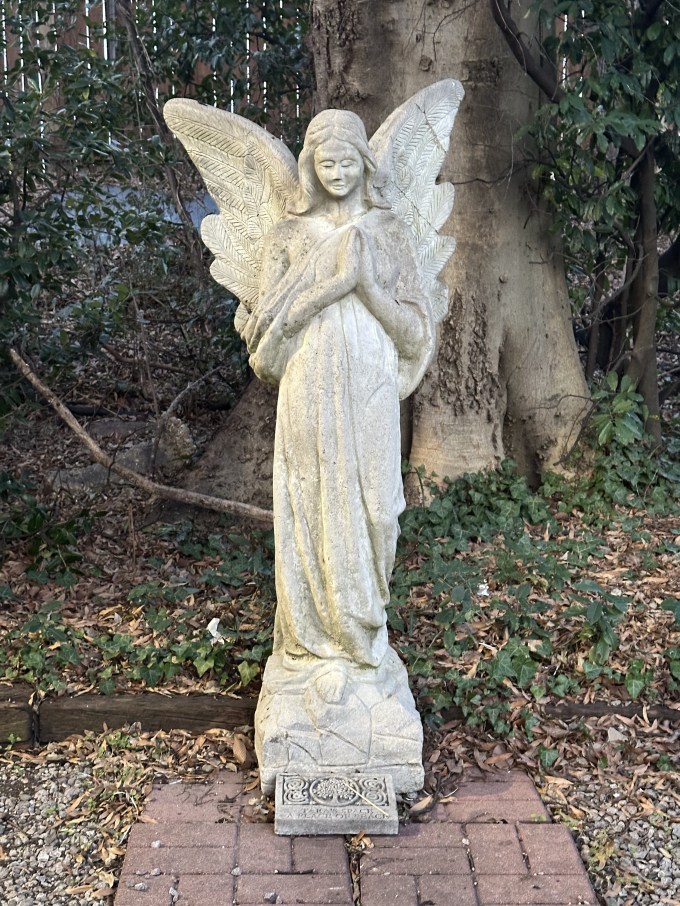
A concrete angel stands in the backyard of Manna House. For several years, it stood with one of its wings broken off. Now it has been repaired, but the scar from the break remains visible. A guest frequently leans his bike against the angel while he drinks his coffee and visits with other guests. On one occasion there was a guest who engaged in conversations with the angel. I am not sure what they talked about but I’m hoping it was about the hospitality we offer. 

More recently, Nancy Weirs and her daughter painted two angels as part of a mural adorning one of the walls of the shed in the backyard. Inside the house there is an angel painting that came from someone as part of a donation. 

I guess we are surrounded by angels, not just in sculpture and paintings but also the kind indicated in Hebrews 13:1-2, “Keep on loving one another as brothers and sisters. Do not forget to show hospitality to strangers, for by so doing some people have shown hospitality to angels unawares.”

In the Bible, angels typically function as messengers from God. When an angel shows up it is apparently startling, if not terrifying, as the first words out of an angel’s mouth is often, “Fear not!!” (Genesis 21:1-21, Luke 2:1-12, Matthew 28:1-10, Acts 27:1-26).

I’m guessing there’s some kind of psychological and even theological connection between the Hebrews 13 notion of angels coming to us under the guise of strangers, and the need to be told “Fear not” by angels who show up unexpectedly. 

In these strange days I need to hear that angelic message, “Fear not.” Maybe the concrete angel with the scar best speaks that message. She’s wounded but healed. The assurance comes from someone who has been broken, has been hurt, but still stands.

I see this, too, in our guests, the strangers who come to Manna House, some of whom must be angels as the Bible testifies. They also often carry an irrepressible spirit. Perhaps this is how they survive under hard conditions. These angels from the streets have a humility connected with humor and hope that gives them a lightness under heavy conditions. As G.K. Chesterton said, “Angels can fly because they can take themselves lightly.” 

I have a lot to learn from these angels encamped around me. God’s messengers come from the streets and gather in the backyard. With their broken wings, they tell me, “Fear not.” They bring the presence of God, as Jesus promised, “whatever I do unto the least of these I do unto him” (Matthew 25:31-46). They tell me in this time to keep hope alive. God isn’t done yet.

Loving Those We See

NOTE: I wrote this in 2014. Sadly, in 2024, in national politics and many churches not much has changed.

One of our Manna House guests is in the hospital. She was brutally beaten, stabbed, and left for dead just a block from Manna House. This guest is an African American transvestite. We lifted her up in prayer this morning when we opened at Manna House. I invite you to do the same. 

Our guests from the streets who are LBGTQ are especially vulnerable. When Manna House first opened nearly 20 years ago, I quickly learned that they were harassed and harmed by other persons on the street, by their families, by random attackers, and by police officers. They are also sometimes even excluded due to their sexuality from places that are supposed to serve people on the streets. 

At Manna House, we’ve been clear: all are welcome here. Further, we do not allow any denigrating language about someone’s sexuality or attire. Everyone is to be treated with respect, with the dignity that they have simply as human beings made in the image of God.

I know that within the broader society and in religious communities, there has been and continues to be quite a struggle over the acceptance of LGBTQ people. As a Christian ethics professor for some thirty years, I’m quite familiar with all of the arguments about homosexuality. The more I have studied the more I have become convinced that based on the Bible, Christian experience, and psychology, the traditional condemnations are wrong. 

But it was not until I became involved with Manna House, that I began to have regular experience with persons LGBTQ people. Many of the arguments I would cover in class were mostly in my head. In offering hospitality to people on the streets, I have also gotten an education in my heart. 

The most painful part of that education is my experience with the suffering of LGBTQ people due to ignorance, and hatred. One story stands out. Several years ago, on the front porch of Manna House, I had a long conversation with an African American LBGTQ guest. In tears, she told me of her being kicked out of her family home by her preacher father before she was even 18. 

She ended up on the streets, turned to prostitution to survive, and to drugs to numb the pain. She showed me the marks on her wrists from multiple suicide attempts. She said to me that she wanted out from the pain of addiction, prostitution, and rejection, of being on the streets. She just wanted to be accepted for who she is. Then she took my hands and said through her tears, “I need you to pray for me.” 

I was taken aback. I had never heard such a desperate plea for prayer. And at this point in my own life, I was not all that comfortable with someone who was transvestite nor with that kind of spontaneous prayer. But I prayed; how could I not?

I prayed that she would experience the truth that she was a child of God, that she would find a home, a place where she would be accepted and loved, and that she could be freed from addiction, and find good work that was not harmful to her. By the time I was done, I felt tears on my face to match hers.

I never saw this person again. I don’t know what has happened to her. I do know that her prayer request deepened my conviction that as Dorothy Day said, “the only solution is love.” I’m tired of arguing about homosexuality with hateful bigots, whether in churches or out. I know how destructive churches and the broader society have been in the lives of those who are LGBTQ, even with the semi-polite arguments about “hating the sin and loving the sinner.” Those arguments still legitimate hatred and I can’t abide them. 

Our Manna House guest lies in a hospital bed now, stabbed, beaten, and struggling to live because of such hatred. And she is, tragically, just another one among many. 

“Those who say, ‘I love God,’ and hate their brothers or sisters, are liars; for those who do not love a brother or sister whom they have seen, cannot love God whom they have not seen” (1 John 4:20).

 Only One Thing is Needed

I find it easy to get distracted. I find it hard to keep my focus. This morning when I arrived at Manna House, I was distracted and found many distractions to stay that way. 

I had a lot on my mind. Who doesn’t these days? There’s plenty of fodder for distraction in politics and culture and in the myriad of debates and memes and more on social media.

I also had things to do. Turn on all the fans. Plug in the coffee pots. Walk through the backyard picking up stir sticks and other trash. Sweep the walkways of leaves, sticks, and gravel, Take donations to the back room. Restock the socks and hygiene baskets. Set up the serving area for socks and hygiene. Set up the coffee serving area. Clean with hot, soapy water the sugar and creamer serving table, and all of the picnic tables and chairs. Prepare “the list” for showers, and “socks and hygiene.”

I worked up a good sweat being distracted. Then, I finally sat down to try and pray. Today was the Feast of St. Mary of Magdala. However, given my distractedness, I did not spend much time with her. Instead, I started to think of other “Marys” in the Gospels. Thus distracted, I re-read the Martha and Mary story (Matthew 10:38-41). There I found an alternative to my distractedness.

Martha complains to Jesus that Mary is sitting around doing nothing. Martha, meanwhile, is busy doing all of the hospitality work for Jesus and the other guests. Jesus tells her, “Martha, Martha, you are worried and distracted by many things, but few things are needed—indeed only one” (Matthew 10:41). I heard my name in what Jesus said, “Peter, Peter, you are worried and distracted by many things, but few things are needed—indeed only one.” I heard Jesus tell me to throttle back.

Only one thing is needed. Only one thing is needed. What is it? Jesus doesn’t say what that one thing is, but the story invites me to hear this, “Be centered on God’s love.” Sit at the Lord’s feet (as Mary did in this story) and take in the presence of Jesus, his words, and his love. As the Psalmist says, “Be still and know that I am God” (Psalm 46:10).

Hospitality involves a lot of work. My list of distractions this morning is just the beginning of each day. It is easy to get lost in that work. It is easy to use the work of hospitality to hide from the guests, or at least keep them distant. 

Efficiency at the work of hospitality can keep me from stopping to listen to stories or hear about an ailment, a loss, or a joy, maybe an upcoming birthday. The work can serve as a cloak that keeps me from compassion. We have a saying at Manna House, “Efficiency is the work of the devil.” It is the work of the devil when it distracts us from serving our guests in which we both welcome them as Christ (Matthew 25:31-46) and they in turn as Christ welcome us (Romans 15:7).

“Be centered on God’s love.” Practice listening. Be silent. Sit down. Or at least slow down. Centered on God’s love maybe I can be enough at ease to accept God’s love, and then I may love too. 

Desert Places

“The Lord your God … has watched over your journey through this vast wilderness” (Deuteronomy 2:7).

A Bible booklet, open to a yellowed and water-stained page, lay abandoned on a front bench at Manna House. The headline, “Desert Places” caught my eye. I was about to lock the gate after a morning of hospitality. Physically, the desert is a stark and hard place to live. Spiritually, the desert is a place of testing, and for vision quest. The desert is a “liminal space” in which there is uncertainty between where one has been and where one might be going. It is a threshold (Latin, “limen”).

            From a spiritual perspective, the desert is a location for spiritual growth. The opening words of the booklet pointed in that direction. “God’s aim is to use the desert places in our lives to make us stronger… God’s goodness is meant to be received in the midst of your pain, not proven by the absence of pain… The desert is not an oversight in God’s plan but an integral part of [our] growth process.”

But such a view is dangerous, perhaps even damaging. Is it God’s plan for people to be on the streets? Is it God’s plan for those experiencing homelessness to suffer, to be in pain? I don’t think so. God is not a masochist who wants people to be in poverty and suffer.

Then a slightly different point was made. “God was with Moses and the Israelites each step of their way through the desert, and He’s (sic) with you and me in ours.” Yes, God can meet people on the streets. Maybe one way this can happen is through Manna House. At Manna House, hospitality intersects with the desert of the streets. We welcome people to cross a threshold for respite from the streets. 

I hope this is what God does at Manna House. God calls us to share hospitality, to offer an oasis in a desert. Guests come for this alternative to the desert, that yet stands near the desert. Our guests come for the shade and slightly cooler temperatures of the backyard, for the cold water, and the showers. But they also come to be welcomed, greeted by name, listened to, and even celebrated (we like to sing “Happy Birthday” when we find out it is someone’s birthday). In hospitality, the desert (for a time) gives way to an oasis we share as volunteers and guests. We reject the desert of a system that judges, denigrates, and excludes people based on race, class, gender, and sexual orientation. We create with our guests a place where all are welcome. 

But as good as that might sound, it is still dangerous. It could easily be deformed into a charity where those offering hospitality are above the guests, dispensing favors, and not being touched by the desert. As I offer hospitality, I need to remember that the harshness of the desert remains. And sometimes it seems like God is not there. Jesus on the cross quotes Psalm 21:1 as he cries out, “My God, my God, why have you forsaken me?” People on the streets are crucified. Harassment, exclusion, ridicule, arrest and imprisonment, the abrupt loss of health, the sudden death of a loved one, losing a job, suffering from addiction or mental illness, not being able to make ends meet, ending up on the streets, where’s God in any of that? 

To practice hospitality, I need to let this desert reality touch me and change me. I need to let it humble me and disabuse me of easy answers. I need to listen and learn from the guests who come, the experts in desert life. I need to practice compassion, not judgment. I need to let God teach me that hospitality is a liminal place where I am emptied of myself when God crosses the threshold as a guest. 

These Shoes Take On Water

The heavy rains Wednesday night soaked our guests. So, they arrived Thursday morning looking bedraggled. One guest, who had a tracheotomy long ago and cannot speak, handed me a slip of paper with this written request, “Can I get a pair of tennis shoes? These take on water.”

His request made me think of a Bible story about another night storm (Mark 4:35-41). The disciples and Jesus were on a boat in the Sea of Galilee. A massive storm suddenly developed and “the waves broke over the boat so that it was nearly swamped.” Like our guest’s shoes, that boat was taking on water. Jesus, meanwhile, was asleep on a cushion near the boat’s stern. The disciples cried out to him, “Teacher do you not care that we are perishing?” 

I went to the back room to look for shoes, size ten and a half. Thankfully, the stock of shoes was good today. 

I returned to the living room. The guest calmly tried on the shoes, looked up, and smiled. He gave me a thumbs-up. The shoes were good. He was good. These shoes would not take on water, at least for a few months. I could feel a wave of peace coming from this man. It is not simply that he cannot speak; there is a stillness about him, a center that will not be rocked.

But what about Jesus? Was he sleeping through the storm again? Does he care that there are people on the streets with shoes taking on water? Does he care that our guests are drowning in a whirlpool of chaos? Where is Jesus in this story from Manna House?

I think Jesus was in the quiet guest. Jesus in the Bible story woke up, rebuked the wind, and said to the sea, “Peace! Be still!” At this “the wind ceased and there was a dead calm.” Then he asked the disciples a few questions, “Why are you afraid? Have you still no faith?”

I had come to Manna House this morning still struggling with my little faith. My reading of “All Saints” took me to Peter Maurin born on this date, May 9th, (co-founder of the Catholic Worker Movement along with Dorothy Day). I had marked this date as also the birth of Daniel Berrigan (peace activist/war resister) and Sophie Scholl (resister to the Nazi regime). I found out later it was also the birthday of John Brown (armed resister to slavery). I thought about how I had ended up at Manna House, through a long line of ancestors in the faith. These included those already mentioned, but also, Murphy Davis, Ed Loring (he’s still alive, but a mentor), Fr. Rene McGraw, O.S.B., my parents, my Grandma Weis. Surrounded by this cloud of witnesses, why should I fear, why would my faith be so paltry?

Then came this guest with his worn-out and wet shoes. And his simple written request, “Can I get a pair of tennis shoes? These take on water.” I could see his quiet dignity, his calm in the storm in which he lives, his trust in this place Manna House to be there for him. So, in him, Jesus broke through and asked me to wake up, to not be afraid. He asked me to realize the strength of the faith I have been graciously gifted with from these ancestors in the faith and from guests who give so much, like this man with his note. The rest of the morning, I felt at peace. Maybe I’m taking on less water. Maybe Jesus isn’t asleep.

To Love What is Mortal

“To live in this world

you must be able 

to do three things:

to love what is mortal;

to hold it 

against your bones knowing

your own life’s journey depends on it;

and, when the time comes to let it go,

to let it go.” –Mary Oliver, “In Blackwater Woods”

Oh girl, that feeling of safety you prize 

Well, it comes at a hard hard price 

You can’t shut off the risk and the pain 

Without losin’ the love that remains 

We’re all riders on this train—Bruce Springsteen, “Human Touch”

“Daily washed the feet of poor people” from the Profile of Saint Oswald of Worcester, Feast Day, February 29 (the day of his death in 992).

“Ain’t nobody got no business mistreating nobody.” –Diane B., guest at Manna House

Hospitality draws us close to serve other people in their vulnerability, their woundedness, even their death. Guests come with needs, some of them physical, which are relatively easy to address. A shower and some clothes, a haircut, “socks and hygiene,” a cup of hot coffee; none of those are all that hard to share. It is the emotional and spiritual needs that require more. To listen or have a conversation with a person who has lost their place to live and have lost work, or sobriety, or family, or friends, or their minds, that takes empathy, compassion, patience, and in all of that, love. 

To practice hospitality with love requires being close, in the same space with those who come. Hospitality means smelling sour breathe, body odor, rotting flesh, shit. Death hangs over hospitality. People on the streets and people in poverty die younger than the general population. One study found the mortality rate for unhoused Americans more than tripled in the past ten 10 years. Another study notes that the average life span of a homeless person is about 17.5 years shorter than the general population. 

I doubt Mary Oliver was thinking about hospitality with people on the streets when she wrote that our own life’s journey depends upon our capacity “To love what is mortal” and “hold it against your bones.” And I’m sure Bruce Springsteen was not thinking about hospitality when he wrote, “You can’t shut off the risk and the pain, Without losin’ the love that remains.” But they both get at something fundamental about love and the practice of love in hospitality. In both we join with others in the shared human condition in which fragility, vulnerability, woundedness, and death are unavoidable. And to recoil from this human condition is to also recoil from love. That is the pathos and the promise inherent to human love. There is no love without risk, and finally without loss. But there is also no human life worth living without love.

This love is at the heart of being a disciple of Jesus. To keep practicing love knowing vulnerability and death is how we practice resurrection. We love, we practice hospitality, by getting close to people and allowing them to get close to us, physically, emotionally, spiritually. St. Oswald, whose Feast Day of February 29th was celebrated Thursday morning at Manna House, understood that a Christian faith that does not touch and is not touched by those who are hurting, abandons Christ who both touched the hurting and was crucified. Thus, St. Oswald, “Daily washed the feet of poor people.”

To practice resurrection is to live the loving conviction that every person is created in the image of God and deserves respect and recognition. As a guest put it this morning at Manna House, “Ain’t nobody got no business mistreating nobody.” Our business in offering hospitality is overturning mistreatment, overturning death with affirmation of life and love, holding people close, holding the love that remains, knowing we’re all on the same train.